Beyond the Noise: A Field Guide to Content Marketing in 2026


Many creators and strategists feel like AI means the end of content marketing as we know it.
That couldn’t be further from the truth.
The strategy is as strong as ever—even if the core principles aren’t entirely new. What has changed are the tools we use, the channels we prioritize, and the standards that set top-performing content marketers apart. Unsurprisingly, the playbook that worked even three years ago no longer holds up.
When every piece has a clear purpose and a multi-platform distribution plan, your media can keep building visibility, trust, and business outcomes long after it’s published. Content marketing is ultimately how you turn attention into trust, and trust into revenue. This guide maps out how to build and execute a defensible content strategy that drives real impact in 2026.
What Makes Content Marketing Work Today?
The content that drives measurable business outcomes does three things consistently:
- Addresses a real problem someone is actively trying to solve.
- Reaches that person when they need help, without feeling like a pitch.
- Nudges them closer to a decision, whether that’s subscribing to a newsletter or requesting a product demo.
If a piece of content doesn’t check all three, it’s filler.
Only 22 percent of B2B marketers say their content programs are highly successful. Of that group, 82 percent credit audience understanding as their primary success factor—not publishing volume or chasing viral trends.
Paid vs. Organic: An Integrated Approach
Audience focus also reframes the traditional paid vs. organic debate. You can't rely on just one. Paid channels deliver instant visibility, while organic content compounds in value over time.
Smart teams run an integrated pipeline:

- Build assets organically to test message-market fit.
- Identify pieces that strike a clear chord with readers or viewers.
- Put paid promotion behind those proven winners to scale reach efficiently.
For small businesses and growing brands, this integrated workflow ensures every marketing dollar pulls its weight.
4 Steps to Build a Stronger Content Strategy
Most content fails due to a lack of strategy. Nearly half of marketers with moderately effective performance cite unclear goals as their biggest bottleneck. These four steps establish the direction required to drive business results.
1. Define Your Audience and Measurable Goals
Vague intentions like "build brand awareness" are wishes, not strategies. Quantifiable targets—such as "add 500 qualified email subscribers this quarter" or "double trial signups from organic search by Q4"—give your team a concrete target.
Define your audience by their specific operational problems rather than high-level demographics:
Example: A 45-year-old SaaS Chief Marketing Officer and a 45-year-old brick-and-mortar retailer look identical in a demographic spreadsheet, but their pain points, decision-making criteria, and content consumption habits are completely different.
2. Choose Channels and Formats Matched to Audience Intent
Focus on formats aligned with how your audience consumes information:
Rather than spreading resources thin across every platform, master one or two core channels before expanding.
3. Establish a Sustainable Publishing Cadence
Consistency consistently beats volume. A weekly cadence that your team reliably maintains builds more momentum than a daily schedule abandoned after a month.
Use an editorial calendar (in Asana, Trello, Monday.com, or a spreadsheet) to plan themes and production schedules a month or quarter in advance. The simplest tool your team will consistently update is always the winning option.
4. Build Distribution into the Pre-Production Process
Publishing content to your website is only the first step; distribution is what delivers eyeballs. High-performing pieces generally require at least two active distribution channels working in parallel.
- If your audience lives on LinkedIn: Repackage key insights into long-form posts, native video clips, or PDF carousels.
- If they consume video content: Cut long-form video or audio assets into 60-second vertical highlights.
- If they prefer written media: Adapt key campaign takeaways into dedicated email nurture sequences.


5 Practical Tips for High-Performing Content Programs
1. Map Content to the Buyer Journey and AI Engine Workflows
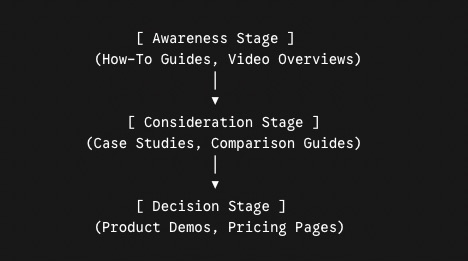
Align your media with the traditional buyer journey stages: Awareness, Consideration, and Decision.
Question-based, highly instructional blog posts and videos do double duty: they serve users at the top of the funnel while matching the retrieval models used by Large Language Models (LLMs) and Search Generative Experience (SGE) engines. Structuring clear, direct answers within your depth pieces secures organic search traffic alongside citations in AI-generated answer engines.
If your current library is heavy on broad top-of-funnel posts but light on case studies, product breakdowns, or decision-stage content, leads will drop off before converting.
2. Prioritize Depth and Authority Over Volume
One well-researched, authoritative asset outpulls ten thin articles.
According to Orbit Media’s survey data, marketers publishing comprehensive, 2,000+ word articles were nearly twice as likely to report strong results compared to those publishing shorter pieces.
Think of high-value content as an appreciating asset. A cornerstone guide or pillar video produced today can generate qualified leads three years down the line.
3. Repurpose Core Assets across Platforms
Content repurposing saves 60% to 80% of the production time required to build assets from scratch.
Identify proven winners—your top organic post, highest-converting webinar, or most shared video—and rebuild the core insight for secondary formats.
- Example: A 1,500-word tactical guide can be converted into a 5-part email course, a series of short social video scripts, and a companion visual summary. Same underlying insight, multi-channel reach.
4. Amplify Proven Organic Assets with Paid Spend
When a blog post reaches page one or a video exhibits high retention, put targeted search or paid social budget behind it. The initial organic traction proves the message resonates; paid amplification scales that performance to a broader target audience.
5. Measure Conversion Outcomes over Vanity Traffic
Traffic and social likes provide visibility, but they do not guarantee revenue. Align analytics tracking around metrics that map directly to business health:
- Organic traffic landing on commercial or product pages.
- Average engagement time on in-depth video and written pieces.
- Direct content conversions (newsletter opt-ins, resource downloads, demo requests).
- Returning visitor rates across core content series.
- Influenced revenue and pipeline attribution per media asset.
Use Google Analytics 4 (GA4) to track engagement behaviors, alongside marketing platforms (HubSpot, Klaviyo, Mailchimp) to measure pipeline conversion outcomes.
Integrating AI Without Losing Unique Brand Perspective
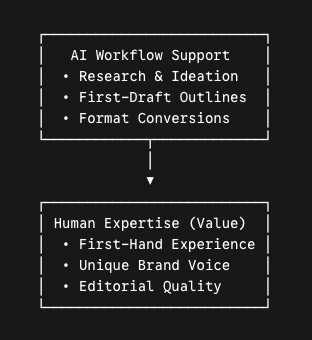
Over 90% of marketers incorporate AI tools into their content production pipelines. AI speeds up the production process, but it does not change what makes content persuasive: original perspective, lived experience, and strategic narrative design.
Where AI Enhances Efficiency
- Research & Ideation: Discovering angles, analyzing topic coverage gaps, and synthesizing broad themes.
- Drafting Outlines: Generating structural skeletons. Over 60% of marketers use AI for initial outlining.
- Format Conversion: Speeding up the transformation of long-form transcripts into initial draft video scripts or social posts.
Where Human Input Is Essential
Search engines and audiences alike prioritize content featuring first-hand experience and original perspective. Automated, generic content created solely to target keyword volume dilutes brand trust and risks search visibility penalties.
Use AI tools to accelerate background research and structural tasks while protecting the human story, brand voice, and domain expertise that builds audience trust.
Frequently Asked Questions
How often should my business publish new content?
Focus on consistency and quality rather than raw volume. Publishing one thoroughly researched, highly polished piece of content weekly or bi-weekly yields better results than releasing thin daily posts that fail to deliver unique value.
How do I know if my content strategy is actually working?
Track performance through down-funnel conversions—such as email list growth, inbound demo requests, and content-attributed pipeline—rather than relying solely on page views or impression metrics.
Can AI replace human content creators?
No. While AI handles structural outlines and fast research, it lacks first-hand industry experience, nuanced storytelling, and authentic creative judgment. The most effective teams use AI as an assistant to handle repetitive tasks while spending more time on strategic narrative, visual production, and editing quality.
Cited Articles & Data Sources
- Orbit Media Studios: Annual Blogging & Content Marketing Survey.
- Content Marketing Institute (CMI) & MarketingProfs: B2B Content and Marketing Trends Report.
- NP Digital Data Insights: Strategic benchmarks on content conversion mapping and paid-organic integration.
- Decades of Industry Expertise — Decades of hands-on experience guiding projects smoothly from concept through final deliverable.
- Streamlined Production Pipelines — Time-tested workflows that eliminate costly bottlenecks and keep projects on schedule.
- Proven Creative Problem Solving — Veteran insight to anticipate roadblocks early and keep your budget locked in.
- High-Impact Quality Control — Deep technical mastery ensuring pristine audio, visual, and narrative execution every time.
- End-to-End Strategic Value — Complete production oversight that maximizes your ROI without sacrificing vision.
- Trusted Industry Network — Strong connections with top-tier talent, specialized gear, and premium resources.
Other Blogs